What to measure
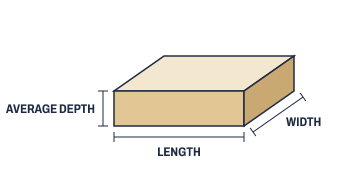
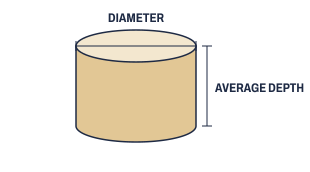
How to use the self-leveling concrete calculator
Enter the floor’s length and width (or its diameter) and the average depth you need to fill. Then enter the bag’s coverage at 1/8 in from the label. The default, 46 sq ft, is the low end of LevelQuik RS’s range. For QUIKRETE’s resurfacer, enter 43. Keep about 10% extra for low spots, leveler that soaks into the primed floor and what stays in the bucket.
The formula
- Volume = area × average depth (depth in feet = inches ÷ 12)
- One bag fills = coverage at 1/8 in × 1/96 ft (46 sq ft × 1/96 = 0.48 cu ft)
- Bags = volume × (1 + extra %) ÷ one bag’s volume, rounded up
- Coverage at your depth = coverage at 1/8 in × (1/8 ÷ depth in inches)
Worked example: 10 × 10 ft floor at 1/4 in
- Volume: 100 sq ft × 0.25 ÷ 12 = 2.08 cu ft
- One bag: 46 ÷ 96 = 0.479 cu ft, or 23 sq ft at 1/4 in
- Plus 10%: 2.29 ÷ 0.479 = 4.8 → 5 bags
Bags per 100 sq ft by depth
50 lb bags, 10% extra. LevelQuik RS at 46 sq ft per bag at 1/8 in; QUIKRETE at 43.
| Average depth | Coverage per bag, LevelQuik RS | Bags, LevelQuik RS | Bags, QUIKRETE |
|---|---|---|---|
| 1/8 in | 46 sq ft | 3 | 3 |
| 1/4 in | 23 sq ft | 5 | 6 |
| 3/8 in | 15.3 sq ft | 8 | 8 |
| 1/2 in | 11.5 sq ft | 10 | 11 |
| 3/4 in | 7.7 sq ft | 15 | 16 |
| 1 in | 5.8 sq ft | 20 | 21 |
| 1 1/2 in | 3.8 sq ft | 29 | 31 |
Common mistakes
- Using the deepest spot as the depth. Fill to the average. A dip that reaches 1/2 in in one corner may average 1/8 in over the room.
- Running short mid-pour. CUSTOM rates LevelQuik RS at a little over 15 minutes of pot life, not enough for a store run. Have every bag, the water and a helper ready before you mix the first one.
- Skipping the primer. Both makers call for it before the pour, and it’s a separate purchase.
- Not sealing the edges. Liquid underlayment finds every gap. Dam doorways and seal holes and joints at the walls before you pour.
Frequently asked questions
How many bags of self-leveling concrete do I need?
For 100 sq ft at 1/4 in, 5 bags of CUSTOM LevelQuik RS with 10% extra. Each 50 lb bag covers about 23 sq ft at that depth, and the extra covers low spots and spills.
How much does a 50 lb bag of self-leveler cover?
LevelQuik RS covers 46–48 sq ft at 1/8 in, 23–24 sq ft at 1/4 in and 11.5–12 sq ft at 1/2 in. QUIKRETE's self-leveling resurfacer makes 0.45 cu ft per bag, just over 21 sq ft at 1/4 in.
How thick can self-leveling concrete be poured?
Both LevelQuik RS and QUIKRETE's resurfacer go from a feather edge up to 1 1/2 in in one pour. For deeper fills, QUIKRETE says to pour layers of 1 1/2 in or less and prime between them.
How do I find the average depth?
Lay a long straightedge or a laser line across the floor and measure the gap underneath on a grid, about every 2 ft. Average the readings. A floor that slopes evenly from 0 to 1/2 in averages 1/4 in.
Do I need a primer?
Yes. CUSTOM says to prime every surface with one of its primers before LevelQuik RS, and QUIKRETE calls for its Concrete Bonding Adhesive, mixed 1 part to 2 parts water. Buy the primer with the bags.
Can I pour self-leveler over a wood subfloor?
Yes, with prep. Both makers call for primer and metal lath fastened over plywood or OSB, and QUIKRETE asks for at least 5/8 in of resurfacer over wood. The subfloor must be sound and stiff.
How many bags for a 12x15 room at 1/2 in?
18 bags of LevelQuik RS. The room is 180 sq ft, which at 1/2 in is 7.5 cu ft, or 8.25 cu ft with 10% extra. Each bag makes about 0.48 cu ft.
Sources
Formulas and defaults last reviewed October 30, 2026. How we check our math.