What to measure
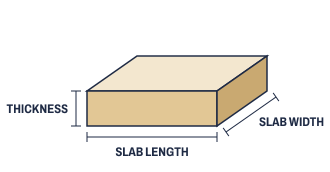
How to measure a slab
Measure the length and width of the area inside your forms, and decide the thickness. For an L-shaped or irregular slab, split it into rectangles, calculate each one, and add the results.
The formula
Cubic yards = length (ft) × width (ft) × thickness (ft) ÷ 27
Thickness is usually given in inches, so divide it by 12 first. Then add your waste percentage. For bags, divide the cubic feet by the bag yield: 0.60 cu ft for 80 lb, 0.45 for 60 lb, 0.30 for 40 lb.
Worked example: 10 × 10 ft patio, 4 in thick
- 10 × 10 × (4 ÷ 12) = 33.33 cu ft
- Plus 10%: 36.67 cu ft = 1.36 cubic yards
- 36.67 ÷ 0.60 = 61.1 → 62 bags of 80 lb
- 36.67 ÷ 0.45 = 81.5 → 82 bags of 60 lb
Bags or a truck?
A cubic yard of bagged concrete is 45 × 80 lb bags — 3,600 lb to lift, mix and place. Most people switch to ready-mix somewhere around one cubic yard. If you do use bags, rent a mixer and line up help: concrete starts setting within the hour.
Concrete for common slab sizes
4 in thick with 10% extra.
| Slab | Cubic yards | 80 lb bags | 60 lb bags |
|---|---|---|---|
| 10 × 10 ft | 1.36 | 62 | 82 |
| 10 × 12 ft | 1.63 | 74 | 98 |
| 12 × 12 ft | 1.96 | 89 | 118 |
| 12 × 16 ft | 2.61 | 118 | 157 |
| 16 × 16 ft | 3.48 | 157 | 209 |
| 20 × 20 ft | 5.43 | 245 | 326 |
| 24 × 24 ft | 7.82 | 353 | 470 |
Common mistakes
- Measuring outside the forms. The concrete fills the space inside the form boards, so measure between them.
- Checking thickness before the base is compacted. Compacting the gravel lowers it, and the slab gets thicker than planned. Measure from the finished base to the top of the forms.
- Forgetting thickened edges. Turned-down edges and footings under a slab add volume. Calculate them as separate pours.
- Ordering with no extra. A slab that is a little thicker in low spots uses more concrete than the plan shows. Keep the waste allowance.
Frequently asked questions
How many bags of concrete do I need for a 10x10 slab?
At 4 inches thick with 10% extra, a 10 × 10 ft slab needs about 1.36 cubic yards — 62 bags of 80 lb, 82 bags of 60 lb or 123 bags of 40 lb. At that size, ready-mix is usually the easier choice.
How thick should a concrete slab be?
4 inches for patios, walkways and most shed floors; 5–6 inches for driveways that carry heavy vehicles. Thicker slabs need proportionally more concrete — going from 4 to 6 inches adds 50%.
Do I need gravel under a concrete slab?
Usually yes — a compacted base of 4 inches or so of gravel improves drainage and gives an even surface. Use the gravel calculator to size the base.
How much does a concrete slab cost?
Enter your local ready-mix price per cubic yard in the optional price field to get a material estimate. Delivery fees, short-load charges, reinforcement and labor are extra.
How much concrete do I need for a 20x20 slab?
5.43 cubic yards at 4 inches thick, or 8.15 cubic yards at 6 inches, both with 10% extra. That is well past the point where ready-mix makes more sense than bags.
How much concrete for a 24x24 garage slab?
7.82 cubic yards at 4 inches and 9.78 cubic yards at 5 inches, with 10% extra. Garage floors often have thickened edges or footings, so add those separately with the concrete calculator.
How many bags for a concrete sidewalk?
A walk 3 ft wide and 30 ft long at 4 inches takes 1.22 cubic yards with 10% extra, or 55 bags of 80 lb.
Sources
Formulas and defaults last reviewed October 30, 2026. How we check our math.