What to measure
How to use the raised bed soil calculator
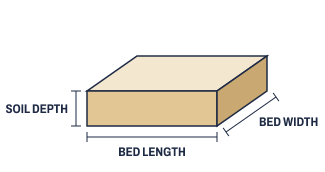
Enter how many beds you’re filling and their inside length and width, then the depth of soil. Set the compost share of the mix and the extra for settling. The results split the order into compost and topsoil, and give bag counts and the bulk cost if you add a price.
For beds of different sizes, work out each size separately and add them up.
The formula
- Cubic feet = beds × length × width × depth (in feet) × (1 + settling)
- Cubic yards = cubic feet ÷ 27
- Compost = cubic feet × compost share; topsoil = the rest
- Bags = cubic feet ÷ bag size, rounded up
Worked example: one 4 × 8 ft bed, 12 in deep
- 8 × 4 × 1 = 32 cu ft × 1.10 settling = 35.2 cu ft
- 35.2 ÷ 27 = 1.3 cubic yards
- 25% compost: 8.8 cu ft of compost and 26.4 cu ft of topsoil
- 35.2 ÷ 1.5 → 24 bags of 1.5 cu ft
Soil for common raised beds
| Beds | Cu ft (+10%) | Cubic yards | 1.5 cu ft bags |
|---|---|---|---|
| One 4 × 8 ft, 6 in deep | 17.6 | 0.65 | 12 |
| One 4 × 8 ft, 12 in deep | 35.2 | 1.3 | 24 |
| One 4 × 8 ft, 18 in deep | 52.8 | 1.96 | 36 |
| One 3 × 6 ft, 12 in deep | 19.8 | 0.73 | 14 |
| One 4 × 10 ft, 12 in deep | 44 | 1.63 | 30 |
| Two 4 × 8 ft, 12 in deep | 70.4 | 2.61 | 47 |
| Four 3 × 8 ft, 6 in deep | 52.8 | 1.96 | 36 |
Common mistakes
- Filling with compost alone. It shrinks fast and lacks the mineral part of soil. Mix it with topsoil or use a raised-bed mix.
- Measuring the outside of the frame. Boards take up space. Measure inside the frame, or the order comes out a few percent high.
- Skipping the settling allowance. Loose mix drops after the first few waterings. Order a little extra, or plan to top up.
- Ignoring the soil underneath. Oregon State suggests loosening the ground and mixing in 2 to 3 inches of compost before filling, so roots can grow down into it.
Frequently asked questions
How much soil do I need for a 4 × 8 raised bed?
At 12 inches deep, 32 cubic feet; with 10% for settling, 35.2 cu ft, which is 1.3 cubic yards or 24 bags of 1.5 cu ft. At 6 inches deep it's half that.
What should I fill a raised bed with?
Oregon State Extension recommends native or topsoil mixed with up to 25% compost by volume, or a planting mix made for raised beds. Don't fill a bed with compost alone; it lacks the mineral part of soil that plants need.
How much compost goes in a raised bed?
Up to a quarter of the volume, according to Oregon State. For a 4 × 8 bed 12 inches deep with settling, that's 8.8 cu ft of compost and 26.4 cu ft of soil.
How deep should a raised bed be?
Deep enough for the roots you plan to grow. Measure the soil depth you'll actually fill, which is usually an inch or two below the top of the frame.
Why does raised bed soil sink?
The compost in the mix keeps breaking down, and loose soil settles after watering. Oregon State says to expect beds to sink and top them up as needed; the calculator adds 10% to start.
Is bulk or bagged soil better for raised beds?
For one or two beds, bags are easier to handle. For several beds, bulk mix by the cubic yard is usually less work. Oregon State's example is four 3 × 8 ft beds filled 6 inches deep with about 1.7 cubic yards of mix.
How many bags of soil for a raised bed?
Divide the cubic feet by the bag size. A 4 × 8 bed 12 inches deep with settling takes 47 bags of 0.75 cu ft, 36 bags of 1 cu ft or 24 bags of 1.5 cu ft.
Sources
Formulas and defaults last reviewed October 30, 2026. How we check our math.