What to measure
How to use the grout calculator
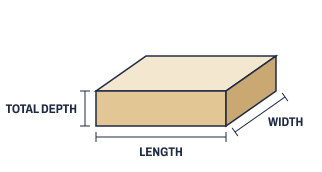
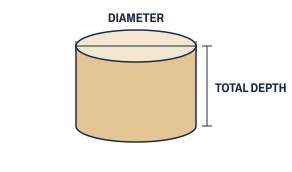
Enter the tiled area, the tile’s length, width and thickness (the joint depth) and the joint width. Keep 10% for waste. The result shows pounds of grout, bag counts and whether to use sanded or unsanded grout.
The formula
Each tile plus its share of joint forms a “cell” of (length + joint) × (width + joint). The joint is the cell minus the tile:
Grout (lb per sq ft) = 144 ÷ cell × (cell − tile area) × depth × 0.064
All dimensions are in inches. The 0.064 lb per cubic inch comes from CUSTOM’s Polyblend coverage chart: it reproduces their figures within a few percent from 1 × 1 in mosaic to 24 × 24 in tile.
Worked example: 100 sq ft of 12 × 12 in tile
- Cell = 12.125 × 12.125 = 147.02 sq in; joint area = 3.02 sq in
- 144 ÷ 147.02 × 3.02 × 0.375 × 0.064 = 0.071 lb per sq ft
- 100 sq ft × 0.071 × 1.10 = 7.8 lb → one 25 lb bag
- Check: CUSTOM’s chart gives 348 sq ft per 25 lb for this tile — 7.2 lb per 100 sq ft before waste
Grout per 100 square feet
Including 10% extra, from the formula above.
| Tile | Thickness | Joint | Grout |
|---|---|---|---|
| 1 × 1 in mosaic | 1/4 in | 1/16 in | 28.9 lb |
| 1 × 1 in mosaic | 1/4 in | 1/8 in | 53.2 lb |
| 3 × 6 in subway | 5/16 in | 1/16 in | 9.7 lb |
| 4¼ × 4¼ in | 5/16 in | 1/8 in | 17.8 lb |
| 12 × 12 in | 3/8 in | 1/8 in | 7.8 lb |
| 12 × 12 in | 3/8 in | 1/4 in | 15.4 lb |
| 12 × 24 in | 3/8 in | 3/16 in | 8.8 lb |
| 24 × 24 in | 3/8 in | 1/8 in | 3.9 lb |
Common mistakes
- Leaving the default thickness. The joint is as deep as the tile is thick; check the tile’s spec sheet or measure one.
- Guessing the joint width. Measure the spacers you’ll use — doubling the joint roughly doubles the grout.
- Using sanded grout on narrow joints or soft surfaces. Under 1/8 in, and on polished marble or glass, use unsanded.
- Mixing the whole bag at once. Mix only what you can work before it starts to set; check the bag for its working time.
Frequently asked questions
How much grout do I need for 100 square feet?
For 12 × 12 in tile, 3/8 in thick with a 1/8 in joint, about 7.8 lb including 10% extra — one 25 lb bag. Small tiles and wide joints need far more; 1 × 1 in mosaic takes about half a 25 lb bag per 25 sq ft.
Sanded or unsanded grout?
Sanded for joints 1/8 in and wider — the sand keeps it from shrinking and cracking. Unsanded for joints under 1/8 in and for easily scratched surfaces like polished marble or glass.
Why does joint width matter so much?
Grout fills the joints, so the amount scales with joint width × depth × total joint length. Doubling the joint from 1/8 to 1/4 in roughly doubles the grout.
How many square feet does a 25 lb bag of grout cover?
From about 54 sq ft (1 × 1 in mosaic, 1/8 in joint) to over 600 sq ft (24 × 24 in tile, 1/8 in joint), according to CUSTOM's Polyblend chart.
How much grout for a subway tile backsplash?
For 30 sq ft of 3 × 6 in tile, 5/16 in thick with a 1/16 in joint, about 2.9 lb including 10% extra — one 7 lb bag of unsanded grout.
How much grout for a 2 × 2 in mosaic shower floor?
A 3 × 5 ft floor (15 sq ft) of 2 × 2 in mosaic, 1/4 in thick with a 1/8 in joint, takes about 4.3 lb including 10% extra — one 7 lb bag.
How much grout for 12 × 24 in tile?
About 8.8 lb per 100 sq ft with a 3/16 in joint and 3/8 in thick tile, including 10% extra.
Sources
Formulas and defaults last reviewed October 30, 2026. How we check our math.