What to measure
How to use the shingle calculator
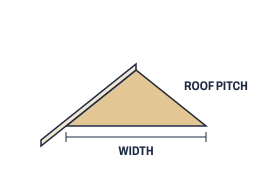
Choose gable or hip. Enter the length and width of the roof at the eaves, including the overhangs, and the pitch in inches of rise per 12 inches of run. On a gable roof the ridge runs along the length. Set the waste and the bundles per square from the shingle wrapper, and add a bundle price to see the cost.
The formula
- Pitch factor = √(1 + (pitch ÷ 12)²)
- Roof area = length × width × pitch factor
- Squares = roof area × (1 + waste) ÷ 100
- Bundles = squares × bundles per square, rounded up
- Gable: eaves = 2 × length, rakes = 4 × (width ÷ 2 × pitch factor), ridge = length
- Hip: eaves = 2 × (length + width), ridge = length − width, plus four hips
Worked example: 40 × 30 ft gable roof, 6/12 pitch
- Pitch factor √(1 + 0.5²) = 1.118
- 40 × 30 × 1.118 = 1,342 sq ft of roof
- 1,342 × 1.10 ÷ 100 = 14.76 squares → 14.76 × 3 = 44.3 → 45 bundles
- Starter and drip edge: 2 × 40 + 4 × 16.77 = 147.1 ft; ridge cap 40 ft
- As a hip roof, the area and bundles stay the same; the edges drop to 140 ft and the ridge cap grows to 100 ft (10 ft ridge + four 22.5 ft hips)
Pitch factors
| Pitch | Factor | Angle |
|---|---|---|
| 3/12 | 1.031 | 14° |
| 4/12 | 1.054 | 18.4° |
| 5/12 | 1.083 | 22.6° |
| 6/12 | 1.118 | 26.6° |
| 7/12 | 1.158 | 30.3° |
| 8/12 | 1.202 | 33.7° |
| 9/12 | 1.25 | 36.9° |
| 10/12 | 1.302 | 39.8° |
| 12/12 | 1.414 | 45° |
Bundles by footprint and pitch
| Footprint | 4/12 | 6/12 | 8/12 |
|---|---|---|---|
| 30 × 24 ft | 26 | 27 | 29 |
| 40 × 26 ft | 37 | 39 | 42 |
| 40 × 30 ft | 42 | 45 | 48 |
| 50 × 30 ft | 53 | 56 | 60 |
| 60 × 32 ft | 67 | 71 | 77 |
A 10/12 roof takes 7–8% more bundles than an 8/12 one: 31, 45, 52, 65, 83 for these footprints.
Three bundles per square and 10% waste. Footprints include the overhangs.
Common mistakes
- Using the house’s floor area. Living area counts every floor and leaves out the overhangs. Measure the roof’s footprint at the eaves.
- Forgetting the pitch. A 12/12 roof has 41% more area than its footprint. Without the factor, the estimate comes up short on any roof steeper than a few inches in 12.
- Counting field shingles for the ridge. Ridge and hip caps are a separate product sold by the linear foot. Order them from the ridge cap figure, not from extra bundles.
- One waste figure for every roof. A plain gable cuts few shingles; a hip roof with valleys cuts many. Raise the waste for complex roofs.
Frequently asked questions
How many bundles of shingles are in a square?
Three for most architectural shingles. A roofing square is 100 sq ft, and GAF Timberline HDZ bundles cover 33.33 sq ft each. Some heavier designer shingles come four or five bundles to the square, so check the wrapper.
How do I measure a roof without climbing on it?
Measure the house footprint on the ground and add the overhang on each side, then find the pitch. The roof area is the footprint times the pitch factor, which is what this calculator does.
How many bundles for a 2,000 sq ft house?
It depends on the footprint, not the living area. A 2,000 sq ft one-story footprint with overhangs at 6/12 pitch has about 2,236 sq ft of roof; with 15% waste that's 78 bundles.
How much waste should I add for shingles?
Roofr puts it at 10 to 15% for most roofs. Use the low end for a plain gable and the high end for hips, valleys and dormers, where more shingles are cut.
Does a hip roof need more shingles than a gable roof?
Not for the area. With the same footprint and pitch, both have the same roof area. A hip roof needs more cut waste, more ridge cap for the hips, and no rake starter.
What is a pitch factor?
The number you multiply the flat footprint by to get the sloped area, equal to √(1 + (pitch ÷ 12)²). A 6/12 roof has a factor of 1.118, so it has about 12% more area than its footprint.
Where does starter strip go?
Along the eaves and up the rakes. GAF's Pro-Start strip is sold for both, at 120 linear feet per bundle. A hip roof has no rakes, so its starter equals the eaves.
What about valleys, chimneys and skylights?
The calculator treats the roof as a simple gable or hip. Valleys and dormers add area and cutting, so measure each extra section as its own rectangle or raise the waste figure.
Sources
Formulas and defaults last reviewed October 30, 2026. How we check our math.