What to measure
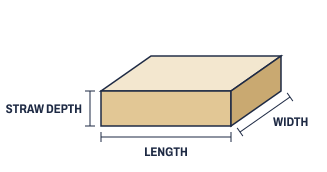
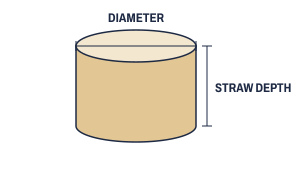
How to use the pine straw calculator
Pick a rectangle or a circle and enter the size of the bed, then the depth of straw you want. Enter what one bale covers and at what depth, from the bale’s tag or the seller. The calculator starts with NC State’s figure for a 40 lb bale: 100 square feet at 2 inches. Add the price per bale to see the cost.
For beds of different shapes, work out each one separately and add the bales up. For a ring around a tree, use the circle and subtract the bare spot at the trunk if it is large.
The formula
- Area = length × width, or 3.1416 × (diameter ÷ 2)² for a circle
- One bale at your depth = bale coverage × bale depth ÷ your depth
- Bales = area ÷ one bale at your depth, rounded up
- Cost = bales × price per bale
Worked example: a 40 × 6 ft bed, 3 in deep
- 40 × 6 = 240 sq ft
- One bale: 100 sq ft × 2 in ÷ 3 in = 66.7 sq ft at 3 inches
- 240 ÷ 66.7 = 3.6 → 4 bales
- At $7 a bale: 4 × $7 = $28
Bales of pine straw by area
Bales that cover 100 sq ft at 2 inches (NC State’s 40 lb bale). For smaller bales, enter their coverage in the calculator.
| Area | Bales at 2 in | Bales at 3 in |
|---|---|---|
| 100 sq ft | 1 | 2 |
| 250 sq ft | 3 | 4 |
| 500 sq ft | 5 | 8 |
| 1,000 sq ft | 10 | 15 |
| 2,000 sq ft | 20 | 30 |
Common mistakes
- Assuming every bale is a 40 lb bale. Bale size varies by supplier and region, and store bales are often smaller. Use the coverage printed on the bale.
- Planning at one depth and spreading at another. Going from 2 to 3 inches takes half again as many bales. Decide on the depth first.
- Piling straw against trunks and siding. Keep it a few inches back from stems and 6 to 12 inches from the house.
- Ordering a full depth for a refresh. Last year’s straw is still there. Top it up with a thin layer instead.
Frequently asked questions
How much does a bale of pine straw cover?
NC State Extension, citing Texas AgriLife, says a 40 pound bale covers about 100 square feet (a 10 × 10 ft bed) 2 inches deep. Many bales sold in stores are smaller, so check the coverage on the bale or ask the seller, and enter that instead.
How deep should pine straw be?
2 to 3 inches, the layer Clemson Extension recommends for pine needle mulch. The calculator starts at 3 inches. A bale spread 3 inches deep covers two thirds of the ground it covers at 2 inches.
How many bales of pine straw do I need for 1,000 square feet?
With 40 lb bales that cover 100 sq ft at 2 inches, 10 bales at 2 inches deep or 15 bales at 3 inches. Smaller bales take more.
My bale says it covers 40 square feet at 2.5 inches. How do I use that?
Enter 40 in "One bale covers" and 2.5 inches in "At a depth of". For a 240 sq ft bed 3 inches deep, each bale then covers 33.3 sq ft, so you need 8 bales.
How long does pine straw last?
About a year before it starts to look dingy, according to University of Georgia Extension. When it turns gray, add a thin layer of fresh straw on top. For a top-up, enter a depth of about an inch.
Does pine straw make the soil acidic?
Not enough to matter. NC State Extension reports that fresh needles are acidic, but as they break down their effect on the soil is no greater than that of other mulches, because soil buffers the change.
How close to the house and plants can I put pine straw?
Clemson Extension advises keeping mulch 2 to 3 inches away from the stems of woody plants and 6 to 12 inches away from the walls of buildings.
Sources
Formulas and defaults last reviewed October 30, 2026. How we check our math.