What to measure
How to use the flooring calculator
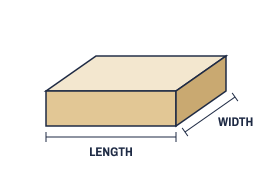
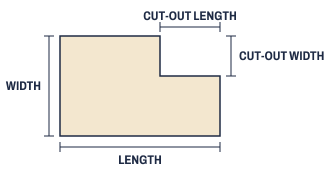
- Pick a rectangle or L-shape and enter the room size.
- Keep 10% extra for a straight plank layout, or raise it for herringbone, diagonal or awkward rooms.
- Enter the square feet per box from the box label.
- Set the underlayment roll size, or 0 if the planks have a pad attached.
The formula
- Flooring to buy = floor area × (1 + extra)
- Boxes = flooring to buy ÷ square feet per box, rounded up
- Underlayment rolls = floor area ÷ roll coverage, rounded up
- Baseboard = room perimeter, 2 × (length + width), the same for an L-shape
Worked example: 12 × 15 ft room
- Floor: 12 × 15 = 180 sq ft; plus 10% = 198 sq ft
- Boxes: 198 ÷ 20 = 9.9 → 10 boxes (200 sq ft)
- Underlayment: 180 ÷ 100 = 1.8 → 2 rolls
- Baseboard: 2 × (12 + 15) = 54 ft
- At $3.50 per sq ft: 200 × 3.50 = $700
Flooring for common rooms
10% extra, 20 sq ft boxes, 100 sq ft underlayment rolls.
| Room | To buy | Boxes | Underlayment |
|---|---|---|---|
| 10 × 10 ft | 110 sq ft | 6 | 1 roll |
| 12 × 12 ft | 158.4 sq ft | 8 | 2 rolls |
| 12 × 15 ft | 198 sq ft | 10 | 2 rolls |
| 14 × 16 ft | 246.4 sq ft | 13 | 3 rolls |
| 16 × 20 ft | 352 sq ft | 18 | 4 rolls |
Frequently asked questions
How much flooring do I need for a 12 × 15 room?
The floor is 180 sq ft. With 10% extra for cuts that's 198 sq ft, or 10 boxes of 20 sq ft (200 sq ft). Add 2 rolls of 100 sq ft underlayment if your planks don't have it attached.
How much extra flooring should I buy?
Havwoods recommends 10% for plank flooring and 15% for herringbone or chevron in areas under 100 m² (about 1,076 sq ft), and 7% and 12% in larger areas. Rooms with many corners, angles or doorways need more.
How do I measure a room for flooring?
Measure wall to wall at the widest points and round up to the next inch. For an L-shaped room, measure the whole rectangle and the missing corner. Measure closets and hallways separately and add them, since the flooring usually runs into them.
How much baseboard do I need?
About the room's perimeter less the door openings. A 12 × 15 ft room has 54 ft of wall; with one 3 ft door that's 51 ft. Buy a little extra for the angled cuts at the corners.
Do I need underlayment?
Most floating floors (laminate and many vinyl planks) need an underlayment unless one is attached to the planks. Follow the flooring maker's instructions; using the wrong one can void the warranty.
Why is the cost based on boxes?
Flooring is sold by the box, so you pay for whole boxes even if you use part of the last one. 198 sq ft becomes 10 boxes of 20 sq ft, and at $3.50 per sq ft you pay for 200 sq ft — $700.
Sources
Formulas and defaults last reviewed October 30, 2026. How we check our math.