What to measure
How to use the baseboard calculator
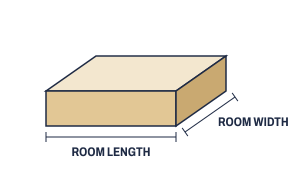
Enter the room’s length and width, the number of doorways and how wide each one is with its casing. Choose the piece length you plan to buy and the extra for cuts. Add a price per piece to see the cost.
An L-shaped room has the same perimeter as the rectangle around it, so enter its overall length and width. Closets and wall jogs add length on top: measure those walls and add them to the total.
The formula
- Linear feet = 2 × (length + width) − doors × door width
- To buy = linear feet × (1 + extra %)
- Pieces = to buy ÷ piece length, rounded up
Worked example: 12 × 12 ft room, one 3 ft door
- 2 × (12 + 12) − 3 = 45 linear feet
- 45 × 1.10 = 49.5 ft to buy
- 49.5 ÷ 16 = 3.1 → 4 pieces of 16 ft (or 5 of 12 ft)
Baseboard by room size
| Room | Linear ft | Pieces: 16 / 12 / 8 ft |
|---|---|---|
| 10 × 10 ft, 1 door | 37 | 3 / 4 / 6 |
| 10 × 12 ft, 1 door | 41 | 3 / 4 / 6 |
| 12 × 12 ft, 1 door | 45 | 4 / 5 / 7 |
| 12 × 14 ft, 2 doors | 46 | 4 / 5 / 7 |
| 14 × 16 ft, 2 doors | 54 | 4 / 5 / 8 |
| 16 × 20 ft, 2 doors | 66 | 5 / 7 / 10 |
| 20 × 24 ft, 3 doors | 79 | 6 / 8 / 11 |
Doors are 3 ft each; pieces include 10% extra.
Common mistakes
- Buying for the total only. A 14 ft wall can’t be covered by two 8 ft pieces without a joint, and leftovers from short walls rarely fit long ones. Where you can, cover each long wall with a single piece.
- Forgetting closets. A closet adds three walls of baseboard. Measure it like a small room and add it to the total.
- Mitering inside corners. Walls are rarely square, so mitered inside corners open up. Coping one piece to the profile of the other hides the gap.
- Nailing into drywall only. Baseboard needs nails into the studs or the bottom plate to stay tight; mark the studs before you start.
Frequently asked questions
How do I measure for baseboard?
Measure the length of every wall at floor level and add them up, then subtract the width of each doorway. For a plain rectangular room that is 2 × (length + width) minus the doors.
How much baseboard for a 12 × 12 room?
The perimeter is 48 ft. With one 3 ft door it is 45 linear feet; with 10% extra for cuts, 49.5 ft, which is 4 pieces of 16 ft or 5 pieces of 12 ft.
What lengths does baseboard come in?
Stores stock 8, 12 and 16 ft lengths. Longer pieces mean fewer joints along long walls; shorter ones are easier to carry and fit in a car.
How much extra baseboard should I buy?
About 10% covers miters at the corners and the odd bad cut. Add more for rooms with many short walls, bay windows or jogs.
Do I subtract the door width or the trim width?
Subtract the full opening including the casing on both sides, since baseboard stops at the casing. A standard 30 or 32 in interior door with its casing comes to about 3 ft; measure yours if it's wider.
How many corners does a room have?
A rectangular room has 4 inside corners. Each needs a cope or miter cut. Closets, chimney breasts and jogs add inside and outside corners; count them in your room.
Should I join pieces in the middle of a wall?
Only when a wall is longer than your longest piece. Use a scarf joint (two 45° cuts) and place it over a stud so both ends can be nailed.
Sources
Formulas and defaults last reviewed October 30, 2026. How we check our math.