What to measure
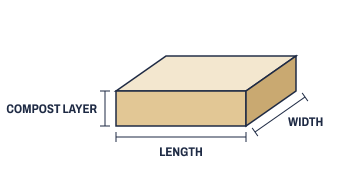
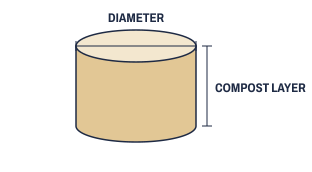
How to use the compost calculator
Pick a rectangle or a circle, enter the size of the area and the thickness of the compost layer you’ll spread before mixing it in. The calculator gives cubic yards for bulk orders and bag counts for 0.75, 1 and 1.5 cu ft bags. Add a bulk price per cubic yard to see the cost.
The formula
- Cubic feet = length × width × layer depth (all in feet)
- Cubic yards = cubic feet ÷ 27
- Bags = cubic feet ÷ bag size, rounded up
Worked example: 10 × 10 ft new bed, 3 in of compost
- 10 × 10 × (3 ÷ 12) = 25 cu ft
- 25 ÷ 27 = 0.93 cubic yards
- 25 ÷ 1 = 25 bags of 1 cu ft (or 34 bags of 0.75 cu ft) — the same answer Oregon State gives for 100 sq ft at 3 inches
How much compost to spread
| Use | Layer | Mix into |
|---|---|---|
| New garden bed | 3–4 in | Top 8–12 in of soil |
| Existing garden bed, yearly | ¼–1 in | Top 8–12 in of soil |
| New landscape planting | 3–4 in | Top 6–8 in |
| New lawn, before seed or sod | 1–2 in | Tilled in |
| Under a raised bed | 2–3 in | The soil beneath |
All rates from Oregon State Extension EM 9308.
Compost by area
| Area | Layer | Cubic yards | 1 cu ft bags | 1.5 cu ft bags |
|---|---|---|---|---|
| 32 sq ft (4 × 8 ft bed) | 3 in | 0.3 | 8 | 6 |
| 100 sq ft | 1 in | 0.31 | 9 | 6 |
| 100 sq ft | 3 in | 0.93 | 25 | 17 |
| 1,000 sq ft lawn | 1 in | 3.09 | 84 | 56 |
| 1,000 sq ft lawn | 2 in | 6.17 | 167 | 112 |
| 800 sq ft | 3 in | 7.41 | 200 | 134 |
Common mistakes
- Spreading 3 inches every year. That rate is for new beds. Established beds need a quarter inch to an inch a year; more builds up nutrients the plants can’t use.
- Leaving it on top. For beds and new lawns the compost works best mixed into the soil, not left as a crust on the surface.
- Coarse compost on lawns and vegetables. Oregon State says compost for those should pass a ⅜ inch screen; chunky compost is fine for shrub borders.
- Comparing bag and bulk prices without converting. A cubic yard is 27 cu ft, so it equals 27 bags of 1 cu ft.
Frequently asked questions
How much compost should I add to a garden bed?
Oregon State Extension recommends a 3 to 4 inch layer on new beds, worked into the top 8 to 12 inches of soil, and a quarter inch to 1 inch a year on existing beds.
How much compost do I need for 100 square feet?
At 3 inches, 25 cubic feet, which is 0.93 cubic yards or 25 bags of 1 cu ft. At 1 inch it's 8.3 cu ft, 9 bags.
How much area does a cubic yard of compost cover?
324 sq ft at 1 inch, 162 sq ft at 2 inches and 108 sq ft at 3 inches.
How much compost for a new lawn?
Oregon State suggests 1 to 2 inches tilled in before seeding or sodding. For 1,000 sq ft that is 3.09 cubic yards at 1 inch or 6.17 at 2 inches.
How much compost for a raised bed?
Before filling, Oregon State suggests mixing 2 to 3 inches of compost into the soil underneath. A 4 × 8 ft bed takes 8 cu ft at 3 inches, or 8 bags of 1 cu ft.
How much does one bag of compost cover?
Oregon State's rule of thumb is that a 1 cu ft bag covers 12 sq ft at 1 inch or 4 sq ft at 3 inches.
Should I buy compost in bags or bulk?
Bags are easier for small beds. For big areas, bulk delivery saves handling; Oregon State gives the example of 7.5 cubic yards covering 800 sq ft about 3 inches deep.
Sources
Formulas and defaults last reviewed October 30, 2026. How we check our math.